
Low-Temperature Water Sources
Aquathermy refers to the extraction of low-temperature heat from natural water bodies such as rivers, lakes, canals, and ponds. These surface waters store solar radiation and atmospheric heat and therefore serve as renewable, stable energy reservoirs throughout the year.
Even at relatively low temperatures (typically 4 – 25 °C), the stored thermal energy can be harnessed using water-source or brine-water heat pumps. The heat pump upgrades this low-temperature energy to a useful temperature level for space heating or domestic hot water.
The usable heat potential depends primarily on:
- Water temperature (seasonal variation),
- Flow rate or water volume, and
- Temperature difference (ΔT) that can be extracted without ecological harm (typically 0.5–3 °C).
In winter, the water temperature of rivers and lakes may drop to around 4–6 °C, whereas in summer it can reach 18–22 °C. This seasonal fluctuation directly affects the efficiency of the heat pump — smaller temperature differences between the heat source and the heating system result in higher performance.
Higher-Temperature Sources: Wastewater and Industrial Effluents
In contrast to natural waters, wastewater from treatment plants and industrial discharges contain higher and more stable temperatures (often 10–25 °C). This makes them particularly attractive for thermal energy recovery.
In wastewater treatment, microorganisms play a key role in biological degradation. They convert organic matter into biomass, CO₂, and water, releasing metabolic heat in the process. Part of this thermal energy remains in the treated effluent and can be captured before discharge into the environment.
Typical applications include:
- Heat exchangers integrated into sewer pipes or effluent channels,
- Heat recovery before the final discharge stage of wastewater treatment plants,
- Reuse of waste heat from industrial cooling processes or data centers.
These higher-temperature sources can achieve greater Coefficient of Performance (COP) values, as the heat pump requires less electrical input for the same heat output.
Estimating the Heating Capacity of Surface Water
The theoretical heating capacity P (in watts) that can be extracted from a water body is calculated using the general heat transfer equation:
where:
Principle of Heat Extraction: The temperature of surface waters is typically within a moderate range throughout the year, making them suitable sources for low-temperature heat extraction.
To make this energy usable for heating, the extracted heat is upgraded by a heat pump to a suitable temperature level for distribution in a thermal network or for direct building supply.
Two main systems are used for extracting heat from water:
- Open System
In the open system, water is abstracted directly from the river or lake and directed through the evaporator of a heat pump. During this process, heat is transferred from the water to the refrigerant, causing it to evaporate. The cooled water is then returned to the source. This system achieves high efficiency but requires careful control of water quality and ecological impacts due to direct interaction with the water body.
- Closed System
The closed system uses a heat exchanger (often called a water-to-brine or water-to-water exchanger) that is installed directly in the water body. Heat from the water is transferred to a closed-loop fluid (commonly a brine solution) which circulates between the heat exchanger and the heat pump. The heat pump then upgrades the thermal energy for further use. Because no water is directly withdrawn or discharged, this system poses fewer ecological and regulatory challenges, though care must be taken to prevent leaks of heat-transfer fluids.
 Figure 1: Diagram of a closed (left) and open (right) system (based on Kammer et al., 2015).
Once extracted and upgraded, the thermal energy is distributed via heating networks. Heating networks are pipeline systems that convey heat from production sites to consumers, using water or steam as the transport medium. Large-scale systems are commonly referred to as district heating networks, while smaller, localized systems are called local or community heating networks. Conventional networks operate at supply temperatures between 70–130 °C, depending on demand and consumer type. Recently, low-temperature networks—often referred to as cold networks—have gained attention. These systems operate below 50 °C, enabling better integration of renewable heat sources and improving overall efficiency. Since the fluid in cold networks can be colder than the surrounding air, pipe insulation is often unnecessary. In cold climates, antifreeze additives (e.g., glycol) are used to prevent freezing.
The process of heat extraction or discharge affects the thermal balance of the water body.
To avoid ecological damage, the natural thermal regime—including temperature, flow dynamics, and water quality—must remain within acceptable limits. key parameters for mapping, such as water temperature regimes, flow rates, and the allowable temperature difference (typically limited to ΔT ≤ 3 K) to avoid harmful effects on aquatic ecosystems. It also recommends a standardized approach using hydrological and geospatial data to identify suitable sites for water heat utilization.
Example: River Heating Capacity in Summer and Winter
Let’s assume a river with a flow rate of 2 m³/s and a permissible temperature extraction ΔT = 1.5 °C.
That means about 12.6 MW of heat can theoretically be extracted continuously.
Now, if the water temperature is 18 °C in summer and 6 °C in winter, the COP of the heat pump changes significantly:
- Summer (18 °C source): COP ≈ 5 – 6
- Winter (6 °C source): COP ≈ 3 – 4
Although the theoretical heat capacity of the water is constant, the efficiency and usable heat output are lower in winter because the heat pump must work harder to raise the temperature to the heating level (e.g., 35–45 °C). In most cases, the surface layer of the water body is most relevant, as turbulent mixing tends to equalize temperatures across the flow cross-section. Water temperature varies daily and seasonally due to changes in air temperature, solar radiation, and hydrological conditions. Typically, colder periods (e.g., winter months) yield lower heat potential, whereas warmer periods (e.g., summer months) yield higher potential.
In the SEETHERMIE study, the energetic potential of utilising lake water for heat-supply was assessed through a comprehensive measurement and modelling campaign. The research team conducted in-situ investigations of the selected water body (a post-mining lake) over one full year, capturing temperature profiles to depths of nearly 50 m in order to characterise seasonal stratification and cold-water volumes SEETHERMIE- JENA-GEOS
Based on observed water temperatures and the lake’s geometry and volume, they derived possible extraction and re-injection scenarios of water for heat extraction. The concept uses vacuum-liquid-ice technology for direct evaporation of the lake water to transfer heat to a downstream heat-pump system. The study defined key operational parameters (e.g., water withdrawal rate ~288 m³ / day, ∆T between intake and discharge of ~0-3 K) and assessed the economic viability (investment costs, expected heat price) and regulatory/limnological feasibility of the system. The result shows that, given the specific limnological conditions and modern extraction technology, the lake-based thermal supply is technically feasible, environmentally acceptable and can deliver a meaningful contribution to a low-carbon heat supply
Importance of water level station Data for Estimating Potential
To assess and map the thermal potential of rivers and lakes, continuous hydrological measurements are essential. Gauge stations (Pegelstationen ) record:
- Water level – indicates flow variations,
- Discharge (Q) – determines available volume flow,
- Water temperature – key for calculating seasonal ΔT and potential,
- Temporal resolution – daily or hourly data reveal seasonal and short-term changes.
For example, in Germany, the Hydrological Service of Thuringia (HNZ) hydrological portal provides real-time water level and temperature data through its hydrological portal (Figure 2). Such open data enable municipalities, planners, and researchers to estimate the thermal potential of specific river reaches and water bodies. These data are thought to help municipalities in cases of flood and monitor the water levels of rivers. Additionally, it serves as a basis for estimating the thermal potential of rivers and streams, as the measured flow rates allow inferences about the available water volume and, consequently, the potential for heat extraction. For reservoirs and other standing water bodies, corresponding information is available through the Thuringian Water and Reservoir Management authorities Thüringer Talsperren- und gewässerkundliches Archiv - Archivportal Thüringen. By combining the volumetric data of these water bodies with additional parameters (e.g., average water temperature and exchange rate), the potential thermal energy supply can be assessed.
By combining flow and temperature data with the heating capacity formula, it is possible to generate GIS-based maps that visualize river-heat potential across different seasons and locations. This analytical approach provides a solid foundation for identifying suitable sites for aquathermal energy systems.
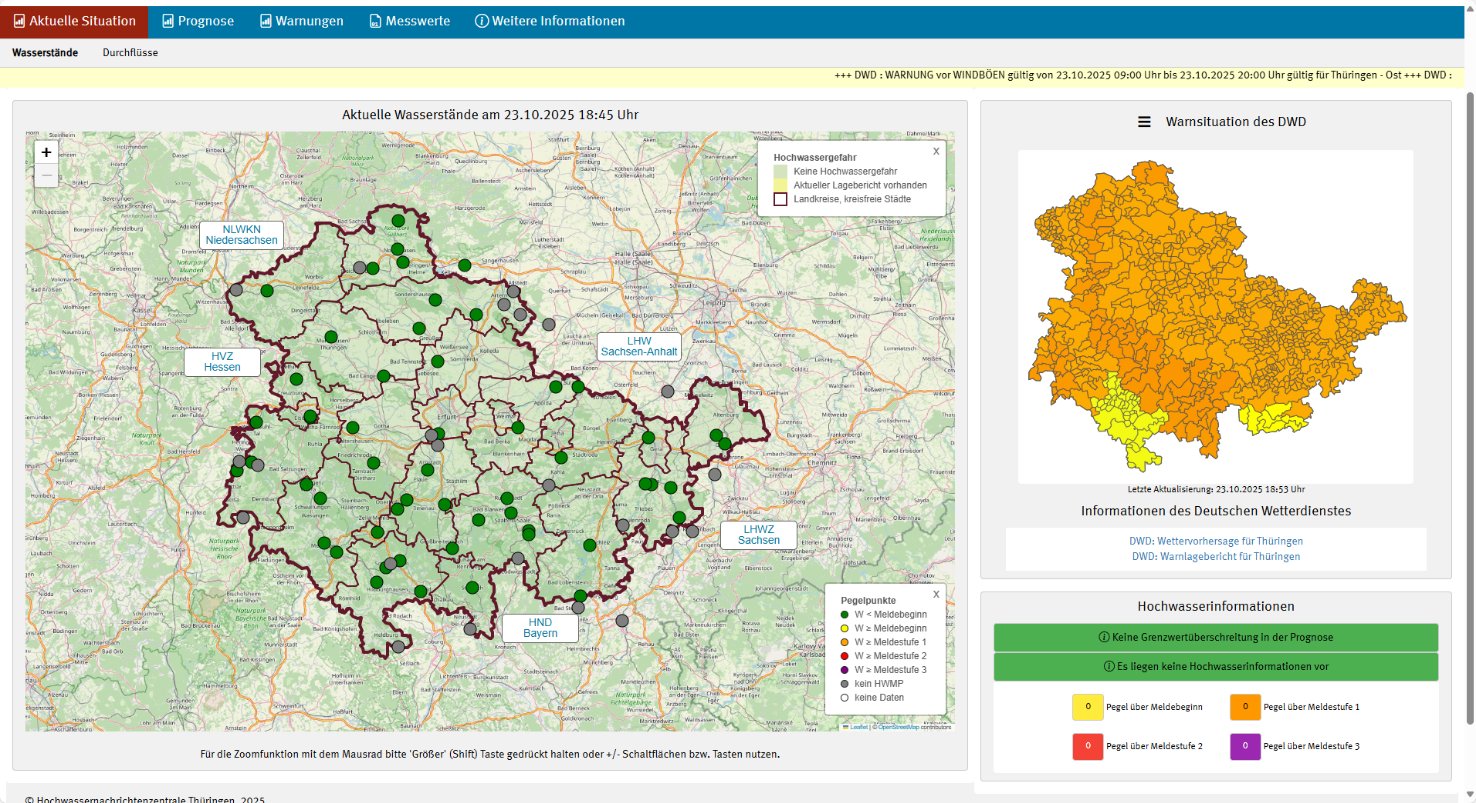 Figure 2: Real-time water level measurement data of rivers in Thuringia. Hochwassernachrichtenzentrale 3.0