
Mapping stakeholders
Engaging stakeholders is essential for the successful implementation of DH transformation processes. Particularly important is the identification of relevant (key) stakeholders for the intended project as a first step. One needs to identify who they are (e.g. consumers, local authorities & spatial planners, citizens, sectoral agencies, national authorities and funding bodies, financers, ...) and assess whether they can support or hinder your plans. This stakeholder analysis should be carried out as soon as possible, ideally in the initial phase, to ensure effective stakeholder engagement throughout the project.
The following table can serve as a basic guide for stakeholder mapping – more information is available further below.
|
Stakeholder |
Role |
How it will be involved |
|
Municipality |
Local regulations etc.. |
|
|
Company 1 |
Waste-heat source provider |
|
|
Company 2 |
Biomass provider |
|
|
Regional authority |
Spatial planning etc. |
|
|
Consumers |
Existing consumers, potential consumers |
|
|
Local energy agency |
Energy strategy developer |
|
|
Regional Development Agency |
Integration into local/regional development plans |
|
Engaging stakeholders
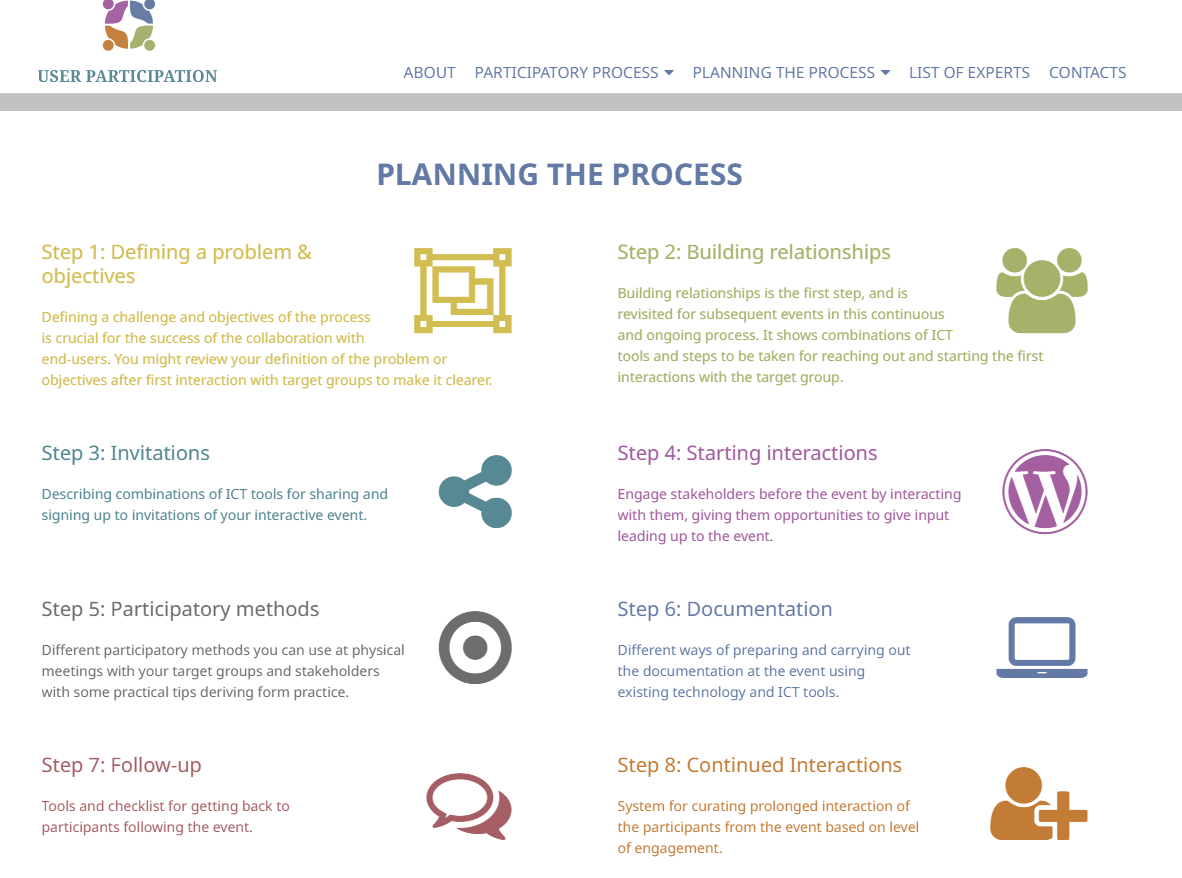
Once you know your stakeholders, you need to assess which should be actively involved in planning or implementing DH transformation process. There are many participatory approaches and methods available, we are offering one that is simple to use and is also involving social media and data sharing platforms: https://www.user-participation.eu/
For advanced users, a special guidebook – Stakeholder Engagement in Heat Networks – A guide for project managers (Carbon Trust) – is available online: https://assets.publishing.service.gov.uk/media/5b292b11ed915d2cc0270d9f/Stakeholder_Engagement_in_Heat_Networks_-_a_guide_for_project_managers.pdf
This guide is designed for individuals involved in heat network development, particularly local authority project managers and sponsors. While it focuses on public-sector projects, its principles apply equally to private-sector stakeholders. It also provides useful insights for other participants seeking to understand the broader development process.
The guide can be read either as a series of stand-alone sections covering specific stages of stakeholder engagement or as a comprehensive manual, giving project managers and sponsors a full understanding of how all elements of stakeholder engagement interconnect within the overall project cycle.